

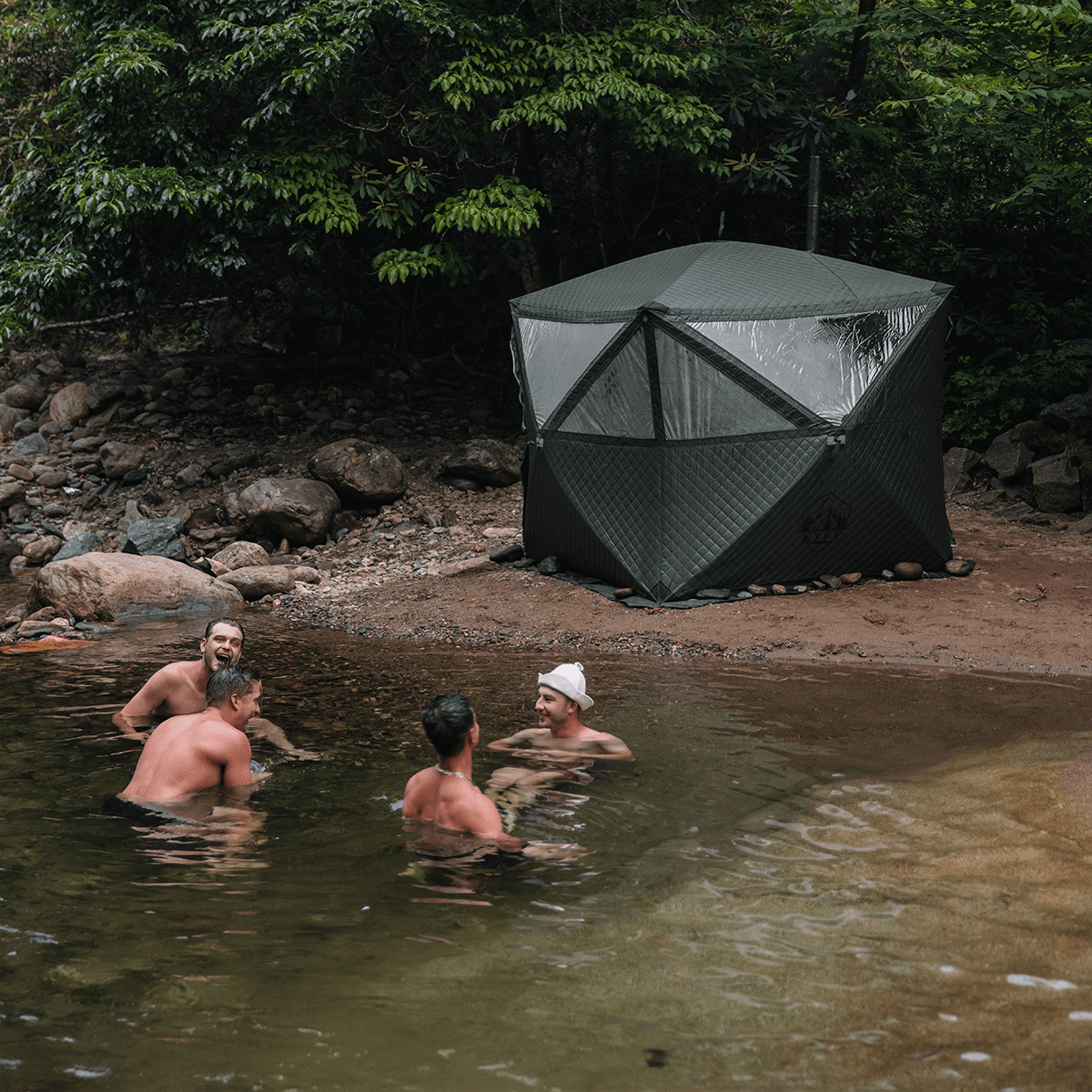
There is a version of sauna that most people know — the solo ritual. You heat it up, you get in alone, you sweat, you think, you come out feeling like a different person. That version is real and it is valuable.
But it is only half the story.
For thousands of years, across cultures on every continent, the sauna was fundamentally a communal space. Finns built saunas before they built permanent homes — and they built them large enough to gather in. Russian banyas were neighborhood institutions. Korean jimjilbangs are as much social hubs as wellness spaces. Indigenous sweat lodges were ceremonial and communal by design. The private solo sauna is a modern construction. The shared sauna is the original.
What's happening now — the rapid growth of backyard sauna culture, portable wood-fired saunas, and outdoor wellness spaces — is not just a health trend. It is a quiet return to something older. And the research increasingly confirms what cultures around the world have practiced for millennia: sweating together is good for you in ways that sweating alone simply isn't.
Why Social Sauna Is Biologically Different From Solo Sauna
This isn't sentiment. There is a physiological case for why shared sauna sessions produce outcomes that solo sessions don't — and it comes down to the interaction between heat and human connection.
When you're in a sauna with others, two powerful biological processes happen simultaneously. The heat triggers the release of endorphins, reduces cortisol, and shifts your nervous system from sympathetic to parasympathetic — the rest and recovery state. At the same time, meaningful social interaction with people you trust triggers the release of oxytocin — the hormone most directly associated with trust, bonding, and stress relief.
Oxytocin and endorphins together produce a neurochemical state that neither delivers alone. Heat without connection produces recovery. Connection without heat produces bonding. Heat with connection produces both — and compounds the effect of each.
A study from Northern Sweden found that social interaction plays a significant role in the overall sauna experience and is directly associated with the anxiety relief, improved sleep, and mental wellbeing outcomes that sauna research documents. The subjects in that study weren't just benefiting from the heat — they were benefiting from the combination.
The North American Sauna Society puts it plainly: social connection, sharing with friends, and feeling part of a community all play roles in the cultural validity of group sweating that has existed across cultures over time.
This is why the Kyfe's outdoor format matters. A wood-fired sauna in your backyard — with the fire crackling, the 360° panoramic view, and space for the people you care about — creates the conditions for exactly this kind of shared experience. Read more about what regular sauna use does for mental health in our post on whether sauna is good for mental health.
The History: Sauna Was Always a Gathering Place
Understanding why social sauna works so well today requires understanding that it was never designed to be private.
In Finland — the culture most associated with sauna in the Western world — sauna was historically the most important room in any home or community. Families gathered in the sauna weekly. Business negotiations happened in the sauna. Babies were born in the sauna. The Finnish saying goes that if medicine, tar, and the sauna cannot help, the ailment is fatal. That's not hyperbole — sauna was treated as a complete healing environment, and healing in Finnish culture was always communal.
The Russian banya followed a similar philosophy. Gathering to sweat together, beat each other with birch branches, and cool in a cold plunge was a social ritual that built trust, dissolved hierarchy, and created the kind of honest conversation that formal social settings prevent. One study found that men who sweat together are more likely to cooperate afterward — what researchers called the social bonding effect of shared physical stress.
In Japan, public bathhouses called sento served as neighborhood social infrastructure. In Korea, jimjilbangs operate as all-day community spaces where families spend hours together eating, sleeping, and sweating. In Indigenous North American traditions, sweat lodge ceremonies were among the most sacred communal practices.
The through-line across every culture is the same: shared heat has always been where people go to be honest with each other. The formality dissolves. The hierarchy flattens. Something about sitting in intense heat together, sweating through the same experience, creates a kind of vulnerability and equality that everyday social settings don't produce. You can read more about the history and purpose of sauna across cultures in our post on what saunas are actually used for.
The Modern Loneliness Problem — and Why Sauna Is Part of the Answer
The timing of the current sauna boom is not coincidental. It is happening at precisely the moment when loneliness and social disconnection have reached crisis levels in the Western world.
The US Surgeon General declared loneliness a public health epidemic. Studies consistently show that chronic loneliness carries health risks comparable to smoking 15 cigarettes a day. Young people — the most digitally connected generation in history — report the highest rates of loneliness. Church attendance is declining. Local pubs and bars are less relevant to health-conscious younger generations. The informal third spaces that historically created community are disappearing.
Sauna is filling that gap in real ways. The number of social saunas and bathhouses in the UK jumped from 45 in 2023 to 147 by 2025. In New York, venues like Othership and Bathhouse are creating communities around shared heat and cold plunge experiences. Community sauna events are growing rapidly across North America.
What all of these spaces have in common is that they offer something genuinely rare in modern life: a screen-free, alcohol-free, hierarchy-free environment where people show up as themselves and conversation happens naturally. The Kyfe creates that same environment at home. Your backyard becomes the gathering space. The fire becomes the focal point. The heat does the social work that cocktail parties and social media cannot.
Read more about what sauna does for stress and mental wellbeing in our post on whether sauna helps with stress.
What Happens When You Bring People Into Your Sauna
The specific social dynamics of a sauna session are worth understanding — because they explain why the conversations and connections that happen in the heat feel different from those that happen anywhere else.
Phones are absent. This is more significant than it sounds. The average person checks their phone 96 times per day. A sauna session is one of the few contexts where that compulsion is completely removed — not because you're trying to be present, but because the environment makes the phone impossible. The people in the sauna have your full attention, and you have theirs. That alone produces a quality of connection that most modern social environments don't allow.
Hierarchy dissolves. In the sauna, everyone is sweating. Everyone is uncomfortable in the same way. There is no performance, no status signaling, no version of yourself that you're maintaining. The physical equalizer of shared heat creates a social equalizer that allows conversations to go to places they rarely go in formal settings.
Silence is comfortable. One of the underrated gifts of shared sauna time is that silence between people feels natural rather than awkward. You don't need to fill every moment with conversation. Sitting quietly with someone in 180°F heat, both of you in the same state, is a form of connection that doesn't require words.
Conversations go deeper. The combination of heat-induced endorphin release, cortisol reduction, and the absence of distractions creates conditions where people open up. Users consistently report that their most honest, meaningful conversations happen in the sauna. It's not magic — it's neuroscience. Lower cortisol means lower defensiveness. Endorphins produce emotional openness. The environment removes the social armor people carry everywhere else.
Practical Ways to Build a Social Sauna Practice With the Kyfe
The Kyfe's format — outdoor, wood-fired, portable — is uniquely well-suited to social sauna use. Here are the most common ways Kyfe owners are building community around their sauna.
Weekly post-training recovery sessions with training partners. Athletes who train together and sauna together report stronger accountability, better recovery conversations, and a shared ritual that reinforces their training commitment. The cold plunge — included free with every Kyfe — turns a post-workout sauna into a complete contrast therapy session. Read more about the combined benefits in our post on 5 potential benefits of sauna and cold plunge.
Sunday family sauna ritual. Many Kyfe owners describe a weekly family session as one of the most valuable practices they've built around their sauna. Teenagers who won't talk at the dinner table talk in the sauna. Couples who spend the week passing each other between work and commitments find genuine connection time in the heat. The shared experience of building the fire, heating up together, and cooling down in the cold plunge creates a ritual anchor for the week.
Sauna nights with neighbors. The Kyfe's outdoor placement and visible fire makes it a natural conversation starter. Several Kyfe owners describe their sauna as having created a neighborhood community that didn't exist before — rotating sessions with neighbors, casual invitations after evening training, an informal gathering that happens around the fire.
Date nights. Shared heat, no phones, the crackling fire, and the cold plunge after — this combination produces a quality of presence and connection that most conventional date activities don't approach. Couples who build regular sauna sessions into their routine consistently report them as a foundation of their relationship's intentional time together.
Hosting seasonal gatherings. The Kyfe's outdoor format, panoramic views, and wood-fired heat make it a natural centerpiece for outdoor gatherings. Winter sessions — where guests rotate through the sauna and cool plunge while others warm by the fire — have become a popular format for Kyfe owners hosting small groups.
The Science of Why Shared Heat Builds Stronger Bonds
Beyond the anecdotal, the research on why social sauna works is increasingly clear.
Shared physical stress is one of the most reliable bonding mechanisms humans have. Studies on group exercise, military training, and team sports consistently show that shared exertion — particularly when it is challenging — builds trust and cohesion more effectively than almost any other shared activity. The sauna produces exactly this effect. You are all in it together. You are all managing the same heat. The shared difficulty creates a shared experience that becomes a shared memory.
Oxytocin — released during meaningful social contact — also has pain-modulating effects. In a sauna context, where you're managing mild thermal discomfort, the presence of trusted people actually makes the heat more tolerable. You stay longer. The session is more enjoyable. The health outcomes improve because the session quality improves.
The post-session state is also worth noting. The combination of heat-induced endorphins, oxytocin from social connection, and the physiological shift from stress to recovery produces what many sauna users describe as a profound sense of wellbeing and ease. That state, shared with others, creates positive emotional associations with those people that compound over time. Regular social sauna use literally makes you like the people you sauna with more — because your brain is associating them with one of the best physiological states you experience.
For more on what consistent sauna practice does to your long-term health, read our post on whether saunas help you live longer.
The Kyfe and the Social Sauna Experience
Most portable sauna options are not social. Infrared blankets are individual. Steam tents are designed for one person. Infrared pods seat one. Even many infrared cabins are designed with the solo user in mind.
The Kyfe is different. The wood-fired tent format accommodates multiple users comfortably. The fire — visible through the stove window — becomes a shared focal point. The outdoor placement means the session exists in the natural world rather than in a room, which changes the social dynamic. The 360° panoramic views mean the environment you're in together is genuinely worth being in. The cold plunge included with every order makes contrast therapy a shared practice.
It's the only portable sauna format that naturally invites others in. And that invitation — to share the heat, the cold, the fire, and the conversation — is one of the most valuable things you can do for the people in your life.
Shop the Kyfe Portable Sauna Tent — everything included, free cold plunge with every order, ships in 1–2 days.
60-day returns. Free shipping on orders $150+. Questions? Call or text +1 (828) 782-8600.
10 High-Impact Things to Do Inside Your Sauna
Sauna and Cold Plunge for Muscle Recovery: The Athlete's Protocol