


A sauna can help you relax, and most bathers walk out feeling calmer. A 1988 paper on how the body handles sauna heat noted that bathers usually describe the feeling afterward as "calm" and "pleasant", and surveys of regular bathers say the same. The research on anxiety and depression is much thinner. Small trials of clinical heat therapy eased symptoms of depression, and no trial we found has tested a sauna as a treatment for anxiety.
Below, we cover how heat exposure affects your stress response, what researchers found on cortisol, anxiety, low mood and sleep, and how to use a sauna to unwind safely. If you live with depression or an anxiety disorder, use the sauna as an extra to the mental health care you already get, and keep working with your doctor or therapist. For the wider health benefits, see our guide to the benefits of a sauna.
Does a sauna help with stress? The short answer
| Question | What studies show | Evidence |
|---|---|---|
| Relaxation | Bathers report feeling calm after a session; mood improved after 20 minutes at 80°C in one small trial | Surveys, small trials |
| Cortisol | Fell in some studies, rose in others, unchanged in others | Small studies, mixed |
| Anxiety | Not tested as a treatment | Very limited |
| Depression | Clinical heat therapy eased symptoms, but in one trial a sham did as well | Small trials, mixed |
| Sleep | Most regular bathers in one survey reported sleep benefits | Surveys only |
| Long-term | Finnish men who went 4 to 7 times weekly had a lower risk of psychotic disorders and dementia | Observational |

What heat exposure does to your stress response
Your body treats a hot sauna as a short physical stress. In a 1989 paper by Kukkonen-Harjula and colleagues, the heart rate of 8 healthy young men rose by about 60% at 80°C, and their noradrenaline, a fight or flight hormone, roughly doubled. A 1988 paper on the sauna's effects on hormones said some of these changes resemble those in any other stress situation, and that they return to normal within a couple of hours.
The calm tends to come afterward. In a 2019 paper, 93 adults with heart disease risk factors sat in a sauna at 73°C for 30 minutes. In the cool-down after that single sauna session, their heart rate variability shifted toward the parasympathetic, "rest and digest" side of the nervous system. That trial had no comparison group, and in a 2025 trial, 8 weeks of sauna use after exercise improved it no more than exercise alone.
Do saunas lower cortisol levels?
Cortisol is often called the body's primary stress hormone, and many articles say a session reduces stress by lowering it. The studies disagree. Cortisol fell during sessions in the 1989 paper. In a 1994 study it fell for the first 15 minutes, then rose, peaking after the bath. In 11 healthy women in 1988, a session had no significant effect on cortisol levels. In 2025, 40 female athletes who used an infrared sauna after training had higher cortisol the next morning at first, and that response settled after six weeks.
That 1988 hormone paper called this research partly contradictory and noted that cortisol usually does not rise in Finnish bathers. It said beta-endorphin may also rise, which may reflect the pleasure of the heat, or its discomfort. Endorphin release was not consistent, either: beta-endorphin rose at 100°C in the 1989 paper and did not change significantly in the women. None of the abstracts we read measured serotonin.
Sauna for anxiety: what we know
No clinical trial we found has tested a sauna as a treatment for an anxiety disorder. The studies that do exist are small:
- In a 2023 paper in Frontiers in Public Health, 22 young women did 20-minute rounds at two temperatures. At 80°C (176°F), their tension, depression, anger and fatigue scores fell. At 120°C (248°F), their mood got worse.
- In the 2019 Global Sauna Survey of 482 regular bathers, relaxation and stress reduction were among the main reasons for going, and those with mental health issues reported some of the biggest improvements.
The side effects reported in that survey were mostly minor, mainly dizziness, dehydration and headache. If bodily sensations like a racing heart can set off your anxiety, talk to your therapist first and keep your first sessions short.
Sauna and depression: the heat therapy trials
Most research on heat therapy and low mood tested whole-body hyperthermia, a supervised procedure that raises your core body temperature, often with an infrared device. Some of these trials used infrared sauna devices, but a supervised clinic session still differs from a sauna at home.
- In a 2016 trial in JAMA Psychiatry, 34 adults with major depressive disorder, not on psychiatric medication, had one session of hyperthermia or a sham session without the intense heat. The heat group had fewer depression symptoms for the 6 weeks that followed.
- In a 2005 trial in Psychosomatic Medicine, 28 mildly depressed patients in hospital were split into two groups. One had 15-minute infrared sauna sessions 5 days a week for 4 weeks. Their physical complaints and relaxation scores improved; their mental complaints only slightly.
- In a 2025 trial, 30 adults with major depression had cognitive behavioral therapy plus either infrared sauna therapy or a sham. Both groups improved a lot, and the sham group did at least as well.
- A 2019 systematic review of 7 studies with 148 participants called hyperthermia promising for depression, but said the evidence is not yet enough for general recommendations.
None of this shows that a sauna can replace therapy or medication for mental health conditions. If you have depression, talk to your doctor or therapist before adding sauna sessions.
Long-term sauna use and mental health
The Kuopio study has followed middle-aged men in eastern Finland for decades. In a 2018 paper, 2,138 men aged 42 to 61 were followed for a median of 24.9 years. Men who used a sauna 4 to 7 times weekly had a much lower risk of a psychotic disorder than men who went once. A 2017 paper on 2,315 men linked the same habit with a reduced risk of dementia and Alzheimer's disease.
These are observational studies, so they show an association and cannot prove the sauna caused the difference. Men who sauna that often may differ in other ways. A 2018 review in Mayo Clinic Proceedings says sauna bathing "may be linked to" a reduced risk of neurocognitive disease.
Sleep quality and mental well-being: what sauna users report

In the Global Sauna Survey, 83.5% of respondents reported sleep benefits after sauna use. In a 2026 Swedish survey, women reported better sleep quality after a sauna, while men did not. In a 2022 health survey in northern Sweden, sauna bathers reported more happiness, better sleep and better mental health than non-bathers, though they were also younger and had healthier lifestyles. In the UK, three studies of 1,907 sauna users published in 2026 linked the social and ritual side of sauna use with better emotional well-being. All of this is self-reported by bathers who already enjoy saunas. Read more in does a sauna help you sleep and the social side of sauna.
What the research does not show
A 2018 systematic review by Hussain and Cohen on the clinical effects of regular dry sauna bathing covered 40 studies, most of them small. It concluded that sauna bathing has potential health benefits and that better research is needed. For mental health, nothing we read shows that a sauna treats anxiety, depression or burnout, or that it reliably lowers cortisol. None of the abstracts tested claims that serotonin or heat shock proteins from the sauna lift your mood, or that contrast therapy builds emotional resilience. Many of these studies included only men, and the hyperthermia trials used supervised sessions, not a home sauna.
How to use a sauna to relieve stress
No routine has been proven best for stress. This is a sensible start:
- Drink water before you go in.
- Sit for about 5 minutes, or until you are warm and sweating.
- Step out, cool off and rest for a few minutes.
- If you feel good, do one or two more rounds.
- Finish by resting for a while and having a drink.
Studies use rounds of 5 to 20 minutes, repeated one to three times. Leave sooner if you feel dizzy, sick or anxious. Our guide to how long you can stay in a sauna has more on timing. No study has set a number of sessions per week for stress. In the Global Sauna Survey, bathers who went 5 to 15 times a month had slightly higher mental well-being scores than those who went less. Leave your phone outside and use the quiet for slow breathing or meditation if you like.
Sauna and cold plunge
A 2023 paper in PLOS ONE looked at the neural basis of "totonou", the name used in Japan for the intense happiness some people feel after a hot sauna and cold water. Participants did three rounds of heat, cold water and rest. Their alpha and theta brain activity rose and they felt more physically relaxed. A cold plunge carries real risks: a 2017 paper in Experimental Physiology describes cold water immersion as a cause of drowning, cardiac arrest and hypothermia. See our sauna and cold plunge routine before you try it.
Infrared saunas or a traditional sauna?
Several hyperthermia trials used infrared sauna sessions or infrared heating devices, while the Finnish research looked at traditional saunas. Nothing we found compared infrared sauna use with traditional saunas for stress or mood. Infrared saunas warm your body directly and run at lower air temperatures. A traditional sauna heats dry, low humidity air and a pile of stones, and splashing the stones makes steam. Pick the one you will use. Compare them in infrared vs traditional sauna.
Who should be careful
- Talk to your doctor or healthcare provider first if you have a heart condition or blood pressure problems, are pregnant, or take prescription medicine. A 2001 paper in the American Journal of Medicine lists unstable angina, a recent heart attack and severe aortic stenosis as reasons not to use a sauna.
- Skip alcohol. The same paper says it raises the risk of low blood pressure, irregular heartbeat and sudden death in the sauna.
- Drink before and after, stand up slowly, and get out if you feel dizzy, sick or confused.
- If chronic stress feels like too much, reach out to your doctor, a counseling service or a crisis line.
See our guide to portable sauna safety. This guide is general information, not medical advice.
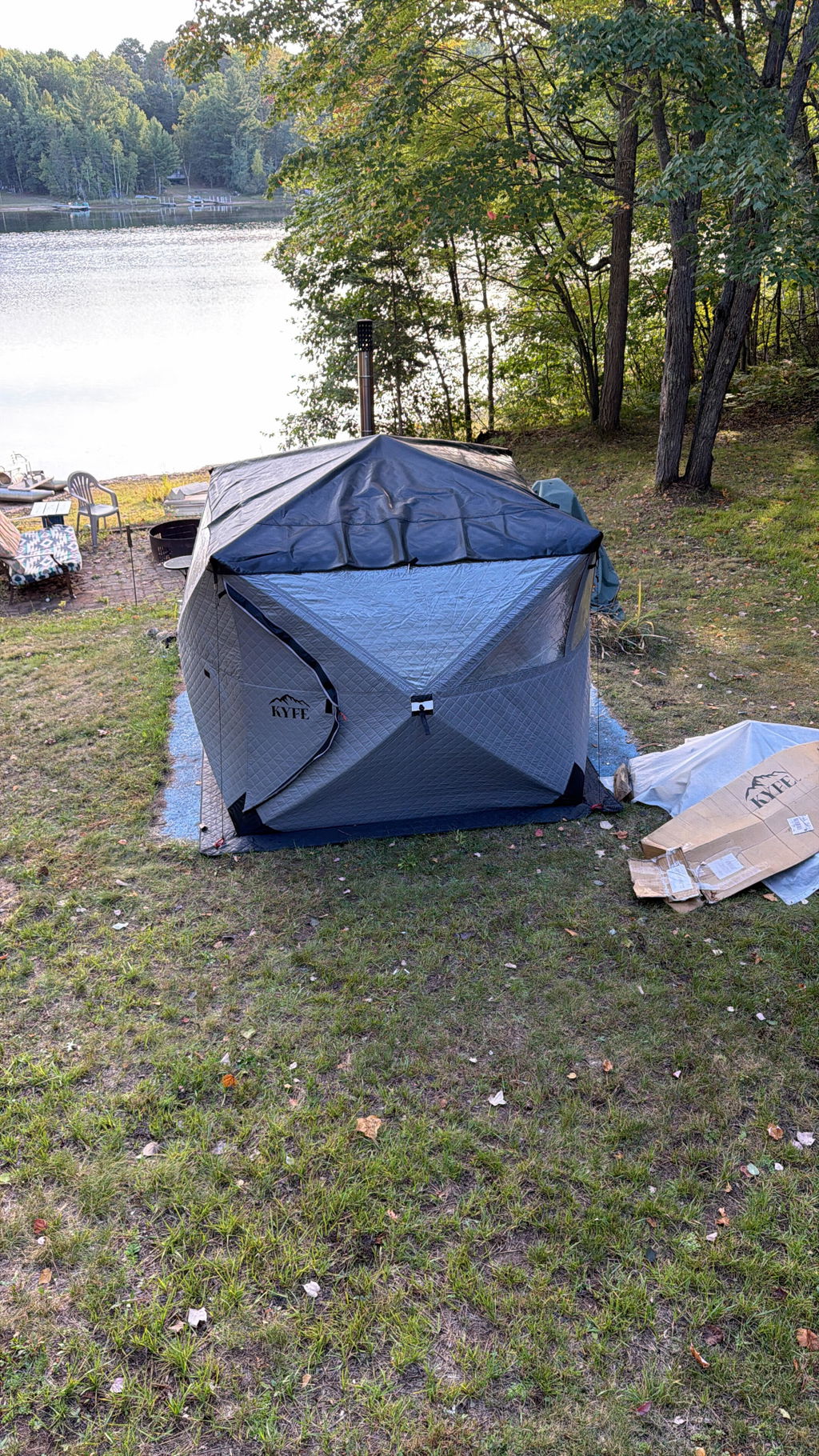
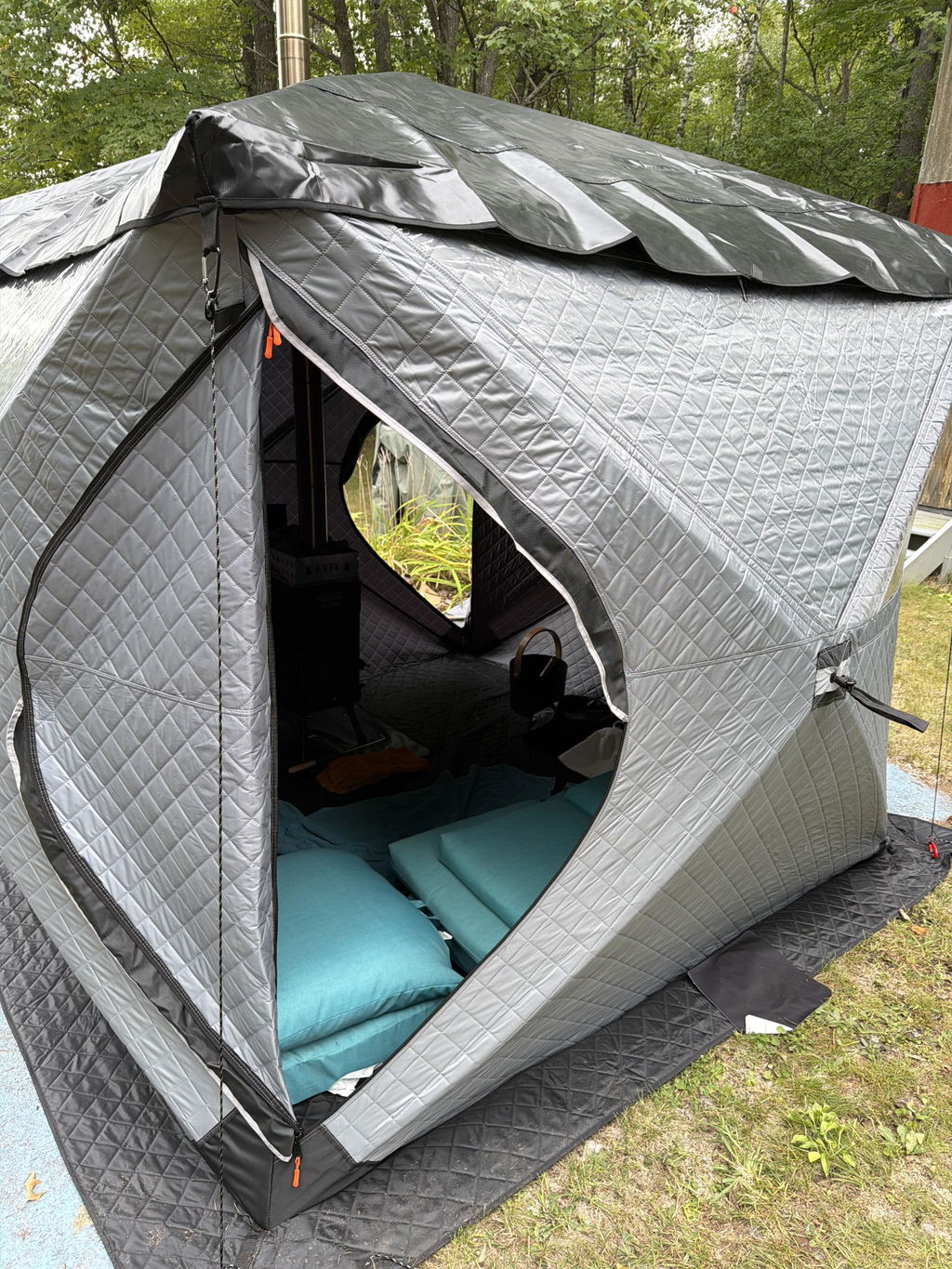
Unwinding in a wood-fired sauna tent
The KYFE Portable Sauna Tent puts a wood-fired sauna in your backyard or at a campsite. It sets up in 5 minutes, burns firewood instead of electricity, and reaches 200°F in under 30 minutes. Pour water on the volcanic sauna rocks for steam. The Mini fits 2 to 3 people and the Large fits 6 to 8, so you can share the heat. At 200°F it sits inside the 176 to 212°F range of a traditional sauna, so keep your first rounds short.

Every tent comes with a free KYFE POD portable ice plunge, a cold plunge tub for hot and cold rounds. Shipping is free in the continental US (not Alaska or Hawaii), you can return an unused sauna within 60 days of delivery, and HSA or FSA funds work through Truemed if you qualify. Use it outdoors only, at least 3 feet from any structure.
Frequently asked questions
Is a sauna good for anxiety?
It may help you relax and feel less tense, but no trial we found has tested a sauna as a treatment for anxiety. In one small trial, a 20-minute session at 80°C lowered tension scores, while 120°C made mood worse. If you have an anxiety disorder, keep working with your therapist and treat sauna time as a relaxing extra.
Do saunas spike cortisol?
Not in most studies. Cortisol fell during sessions in some and rose after the sauna in others, and a 1988 paper noted that it usually does not rise in Finnish bathers. In female athletes, an infrared sauna after training raised next-morning cortisol at first, and the response settled after six weeks of regular use.
Does a sauna reset your nervous system?
Not in a lasting way that research has shown. During a sauna session, your pulse and stress hormones like noradrenaline rise. In the cool-down, one trial found heart rate variability shifted toward the calming, parasympathetic side. But in an 8-week trial, adding a sauna after exercise did not improve it more than exercise alone.
Can a sauna help with depression?
Clinical heat therapy eased symptoms of depression in small trials, and a 2019 analysis called it promising. In a 2025 trial, a sham version worked as well, so the evidence is mixed. A home sauna is not a treatment. Talk to your doctor or therapist before adding sauna sessions to your routine.
How long should I stay in a sauna to relieve stress?
Start with rounds of about 5 minutes and build up as you get used to the heat. Sauna research uses rounds of 5 to 20 minutes, repeated one to three times, with a few minutes of cooling off between them. Longer and hotter is not better: in one trial, mood got worse at very high heat. Leave whenever you feel dizzy or unwell.
Is Sauna Good For Blood Circulation? What You Need to Know
Does Sauna Help You Sleep? Benefits You Should Know