


There is no proven best time of day to use a sauna for weight loss, because no study has tested one. Most of the weight you lose in a sauna is water weight that you sweat out, and it comes back when you drink. If you want to use a sauna as part of a plan to lose weight, the most practical time is right after a workout, or whenever you will keep doing it.
If you have stepped on the scale after a sauna session and wondered whether sauna use can help you lose weight, this guide explains what is going on. We cover what heat exposure does to your body, what the research says about water weight and fat loss, how to time sauna sessions around exercise, how often and how long to go, and how to stay safe.
The short answer
- No time of day has been shown to work better for weight loss in a sauna. We found no study that compared morning, evening and post-workout sessions.
- The weight you lose in a single sauna session is mostly water weight from sweat, and you are meant to drink it back.
- The one controlled trial we found that added sauna bathing to an exercise program put a 15-minute sauna right after each workout. The exercise is what changed body fat. The sauna added health benefits: a bigger gain in fitness, and lower blood pressure and cholesterol.
- Avoid a long sauna right before cardio. Starting a run or a ride already dehydrated likely makes your performance worse.
- Pick a time for regular sauna use that you can stick with.

Can a sauna help you lose weight?
Using a sauna lowers the number on the scale for a while. It has not been shown to help you lose fat on its own.
When you are sitting in a sauna, your body temperature rises and you sweat to cool down. The fluid you lose shows up on the scale. That is temporary weight loss: once you rehydrate, the weight comes back.
Real weight loss, the kind that lasts, means losing body fat mass. The research below shows little evidence that sauna bathing alone does that. Sauna use may help with weight loss as part of a routine built around regular exercise, because sauna sessions fit easily after a workout and many people enjoy them enough to keep going.
How your body responds to sauna heat
Your heart works harder in the heat. In a 2019 study in Complementary Therapies in Medicine, researchers measured heart rate and blood pressure in 19 healthy adults during a 25-minute sauna session. Both rose steadily the whole time. Compared with an exercise test, the load on the heart matched moderate exercise at about 60 to 100 watts.
After the session, blood pressure dropped below where it started. That is one reason to stand up slowly when you leave the sauna room.
So in the heat, your heart works about as hard as it would during moderate exercise. None of the studies we read showed that this extra work burns fat.
Water weight vs fat loss
Water weight is the fluid your body holds and loses through sweat. Fat loss is a drop in body fat mass. A sauna causes the first. Every study we read that weighed people before and after a sauna treated the drop as fluid loss.
If the scale reads lower after sauna bathing, enjoy the session, then drink water. Do not count water weight as progress toward a weight loss goal.
Body mass loss: how much weight you lose in a sauna
Researchers have measured body mass loss in the sauna in several studies. In each one, the weight people lost was fluid from sweat.
| Study | Who took part | Time in the sauna | What happened to body mass |
|---|---|---|---|
| 2014, The Scientific World Journal | 674 young sedentary students aged 19 to 20 | Two 10-minute sessions lying in a dry sauna, 5-minute break | Heavier students lost the most, underweight students the least |
| 2019, BioMed Research International | 45 young overweight, sedentary men | Four 10-minute sessions with 5-minute cool-down breaks | Body mass dropped 0.65 kg (about 1.4 pounds) |
| 2003, International Journal of Sports Medicine | 12 athletes, 6 men and 6 women | Three 20-minute sessions with 5-minute rests | Weight fell 1.8% in the men and 1.4% in the women |
| 1997, Physiology and Behavior | 30 men | 2 hours in a sauna, compared with 2 hours of cycling | About 3% of body mass lost after the sauna and after cycling |
Heavier people lose more fluid
The 2014 study of young sedentary women and men found that body mass index made a difference. Underweight students lost the least weight in the sauna, normal-weight students lost more, and overweight and obese students lost the most. The authors said people with a high BMI are at higher risk of dehydration and should pay attention to replacing fluids. They offered their equations as a way to estimate how much fluid to drink back after a visit to a dry sauna.
Four sauna sessions in an hour
The 2019 study put 45 overweight men through four sauna sessions of 10 minutes each, at 90 to 91°C, with short cool-down breaks between them. Heart rate, blood pressure and energy expenditure rose across the four sessions. These changes, and the body mass loss, correlated most strongly with the men's body size and body fat. After the full 60 minutes in the Finnish sauna, the average body mass loss was 0.65 kg.
The researchers call these measurements physiological parameters (heart rate, blood pressure, energy expenditure) and anthropometric features (body measurements such as weight, BMI and body surface area).
Does the fluid loss come back?
Yes, and that is the point of drinking fluids after a sauna. It may not come back in minutes, though. In the 2003 study, the participants drank a sports drink for an hour after three sauna sessions, and the weight they lost through sauna-induced dehydration still had not fully returned.
That study also found a cost. The men's strength and jumping were unaffected, but the women showed a statistically significant decrease in squat jump height after rehydration, compared with before the sauna. The drop in jump height tracked how much weight each woman had lost.
Does sauna burn fat?
We found no good evidence that sauna bathing on its own reduces body fat. The studies are small, and they point in different directions.
What studies on body fat and body composition found
- A 2020 study in the Korean Journal of Family Medicine gave 38 adults with a BMI of 25 or more a 15-minute dry sauna at 90°C twice a day for 4 days. Their quality of life scores improved. Their BMI, blood pressure, heart rate and body composition did not change in any significant way.
- A 2003 review in Experimental Biology and Medicine reported that obese patients' body weight and body fat dropped after 2 weeks of sauna therapy. The abstract does not say how many people took part or whether there was a comparison group.
- A 2021 study in the International Journal of Environmental Research and Public Health gave 12 sessions of sauna bathing at 100°C to a group of healthy young men (23 in all, including a control group) and measured them with DXA scans. It reported small gains in leg muscle mass and bone measures. It did not report a drop in body fat.
- A 2022 randomized controlled trial in the American Journal of Physiology split 47 adults with low physical activity levels, average age 49, each with at least one risk factor for heart disease, into three groups for 8 weeks: regular exercise with a 15-minute sauna after each workout, regular exercise alone, or no change. Exercise improved fitness and body composition. Adding the sauna gave a bigger gain in fitness, lower systolic blood pressure and lower total cholesterol than exercise alone. The abstract does not list fat mass among the sauna's added health benefits.
Calorie burn and energy expenditure in the heat
Your body does use some extra energy during sauna use, because your heart rate rises and your body works to shed heat. In the 2019 study, energy expenditure went up across the four sauna sessions and correlated most strongly with body size and body fat. How many calories that adds up to is a separate question, which we cover in does sauna burn calories.
The heat also does not act on your appetite the way exercise does. In the 1997 study, 30 men sat in a sauna, cycled, or rested on separate occasions, each for the same length of time. Both the sauna and cycling raised thirst and fluid intake. Only cycling lowered hunger and the amount of energy they ate afterward.
Belly fat, metabolism and other claims
You will find claims that a sauna melts belly fat, speeds up your metabolism, puts you in a fat-burning state when you go in fasted, or slims you down by lowering stress hormones. We looked for studies behind these and did not find any that showed it. We also found no study showing that a sauna can shrink one part of your body. If someone tells you otherwise, ask to see the study.
Best time to use a sauna for weight loss
Since no time of day has been shown to work better, choose your sauna time by how it fits your training, your hydration and your day.
| When | Why it can work | What to watch |
|---|---|---|
| After a workout | Easy to add to a routine, and the setup used in the 2022 exercise and sauna trial | You have already sweated, so drink water before you go in |
| Before a workout | A few minutes of warmth if you like it | A long sweat before cardio can leave you dehydrated |
| Morning | Fits people who train or have free time early | Going in fasted has no proven benefit |
| Evening | A way to unwind at the end of the day | Leave time to rehydrate, and skip alcohol |
| Rest days | Keeps your sauna routine going on days off | Same hydration rules apply |

After a workout
For most people this is the easiest time. You are already warm, and you have already set the time aside. It is also how the 2022 trial did it: a 15-minute sauna right after each exercise session. In that trial, the people who added the sauna improved their fitness and blood pressure more than those who only exercised.
Let your breathing settle first. Drink water before you go in, because you have already lost fluid to sweat during the workout. Keep the first session after a hard workout short. For more on fitting heat around training, read sauna before or after the gym.
Before a workout
A long, sweaty session right before you train is the one timing we would avoid. A 2020 meta-analysis in Sports Medicine pooled 15 studies in which people began running or cycling already dehydrated. Starting out dehydrated likely made their endurance performance worse. If your workout is what helps you lose weight, you do not want to start it short on fluid.
If you like a few minutes of warmth before you train, keep it short and drink water.
Morning sessions
A morning sauna suits people who have time early or train early. Some articles claim a fasted morning sauna taps into fat reserves. We found no study that shows this. If mornings are when you can do it, go then. Drink a glass of water before you start.
Evening sessions
Many people use sauna bathing for relaxation and to unwind at night. We found no study showing that an evening session helps weight loss through better sleep, so treat it as a matter of what you enjoy. Leave time to drink water before bed. Do not pair an evening sauna with alcohol (more on that in the risks section below).
On rest days
Sauna sessions on days you do not train keep the habit going, though they do not replace a workout.
How often should you use a sauna for weight loss?
No study has tested how often to use a sauna to lose weight, so we cannot give you a number for that goal.
The best-known research on regular sauna use looked at heart health, not weight. A study published in JAMA Internal Medicine in 2015 followed 2,315 men in eastern Finland for a median of 20.7 years. Men who used a sauna 4 to 7 times a week had a lower risk of sudden cardiac death, fatal heart disease and death from any cause than men who went once a week. That was an observational study, so it shows an association, not proof that the sauna caused the lower risk.
A sensible start is two or three sauna sessions a week, after workouts where you can. Build up from there if you enjoy it and feel well. If you are thinking about going every day, read can you sauna every day.
How long should you stay in a sauna for weight loss?
No study shows that sitting in a sauna for longer periods burns more fat. A longer session mostly means you lose more fluid and put more strain on your heart.
Sauna studies use rounds of 5 to 20 minutes, repeated one to three times with a cool-down between them. Start at the short end, around 5 minutes, and add time as your body gets used to the heat. In the study from Finland, sauna sessions longer than 19 minutes went with a lower risk of sudden cardiac death than sessions under 11 minutes. That finding was about heart health. The study did not look at weight.
The 2019 study of overweight men is a useful warning here. The changes in heart rate and blood pressure grew with each successive sauna session, and the most harmful cardiovascular responses showed up in the most obese men with the largest bodies. If you are carrying extra weight, build up slowly. For more detail, read how long you can stay in a portable sauna.
How to use a sauna as part of a weight loss routine
If you are using a sauna to help you lose weight, treat it as an extra on top of your weekly exercise and the way you eat.
- Drink water before you go in.
- If you want to know how much fluid to replace, weigh yourself before and after. The difference is mostly water weight, so drink it back.
- Sit for about 5 minutes at first, working up to no more than 20, then step out and cool down for a few minutes.
- Repeat for two or three rounds if you feel well.
- Get out as soon as you feel dizzy, lightheaded, nauseous or unwell.
- Stand up slowly at the end, since blood pressure can dip after a session.
- Rehydrate and eat as you normally would.
- Track your weight on the same scale at the same time of day, before a sauna, never right after one.
Dry sauna, infrared or steam room: does the type matter?
We found no study that compared fat loss between a dry sauna, an infrared sauna and a steam room. Any of them will make you sweat, and the drop on the scale is fluid either way.
The studies above mostly used traditional saunas: a dry Finnish sauna with hot air and low humidity. An infrared sauna uses infrared panels to warm your body more than the air around you, so the air stays at lower temperatures. Steam rooms surround you with humid air. They feel different, and that may decide which one you enjoy enough to use regularly. To compare them, read infrared vs traditional sauna and is sauna or steam room better for weight loss.
Sauna and cold plunge for weight loss
Many people pair sauna bathing with a cold plunge. Claims that the cold burns fat go beyond what has been tested. A 2017 review of cold water immersion in Experimental Physiology found that the evidence behind the claimed benefits varies, and some of it is still anecdotal. The same review looks at cold water as a cause of drowning, cardiac arrest and hypothermia, so take it seriously.
If you lift weights, there is one more thing to know. In a 2015 study in the Journal of Physiology, 21 men did strength training twice a week for 12 weeks. The group that sat in cold water for 10 minutes after each session gained less strength and muscle than the group that did active recovery. If building strength is part of your plan, keep cold plunges away from your lifting days. Our sauna and cold plunge routine covers how to do it safely.
Risks and health implications to know
A 2001 review in The American Journal of Medicine found that most healthy adults tolerate sauna bathing well. The risks go up when you rely on sauna use to sweat off weight, stay too long, or go in with a health problem.
- Every study above recorded fluid loss, and people with a higher BMI lose more fluid and are at higher risk of dehydration. Drink water before and after.
- Your heart rate and blood pressure rise in the heat. In the 2019 study, the most harmful heart responses showed up in the most obese participants.
- The 2001 review warned that drinking alcohol while sauna bathing raises the risk of low blood pressure, an irregular heartbeat and sudden death. Do not drink before or during a sauna.
- The same review listed unstable angina, a recent heart attack and severe aortic stenosis as reasons not to use a sauna.
- Sweating out water to make a weight class or hit a target can hurt your performance, as the 2003 study of athletes found in its female participants.
- Dizziness, a headache, nausea, confusion or feeling faint all mean the session is over.
Talk to your doctor or healthcare provider before you start if you are pregnant, have a heart condition or high blood pressure, or take medications that could affect how you handle heat. Our guide to sauna safety covers more. This article is general information, not medical advice. This guide is general information, not medical advice.
Using a KYFE sauna tent in your routine
If you work out at home, a sauna in your backyard turns a post-workout session into a few steps instead of a drive to the gym.

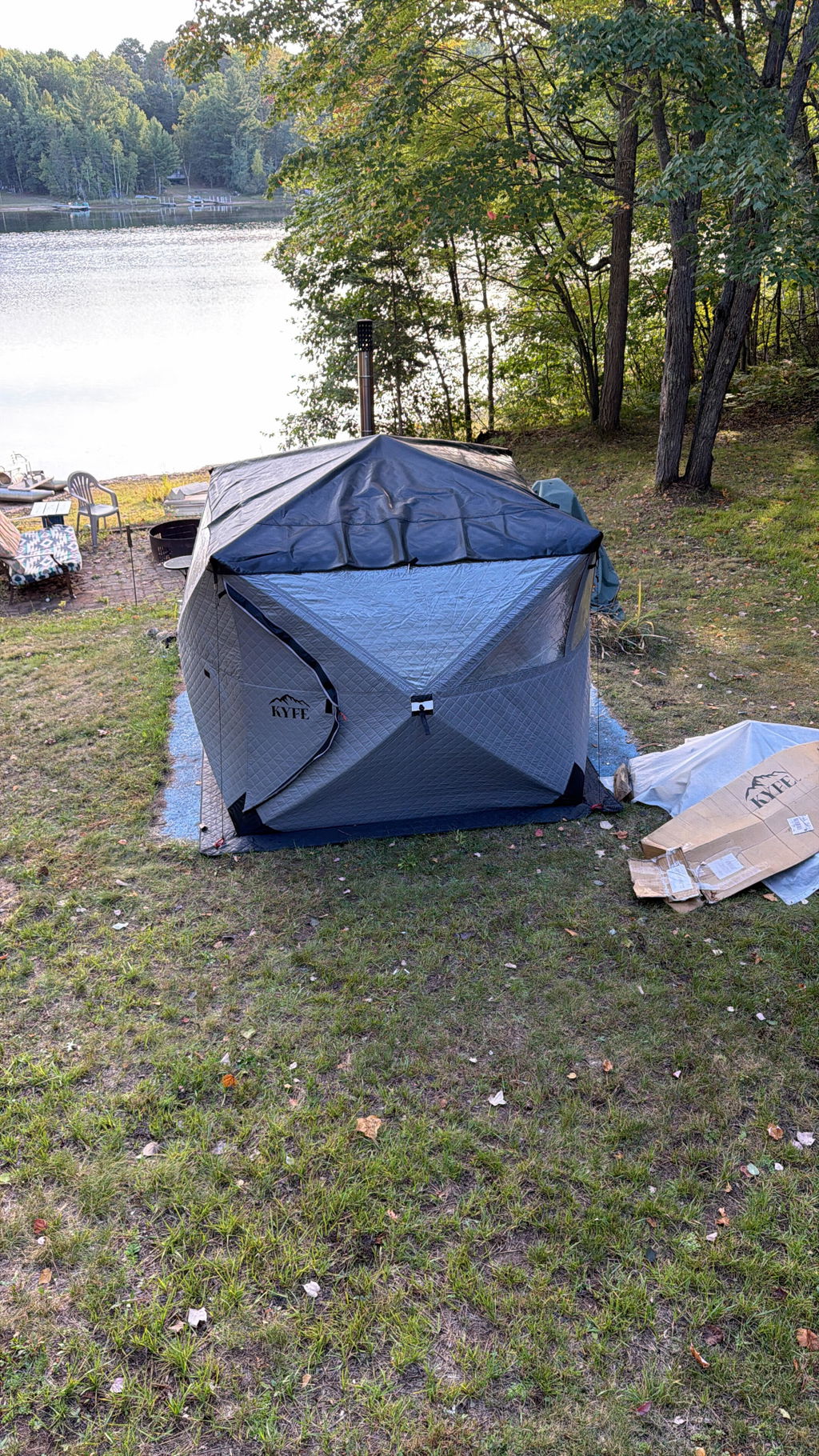
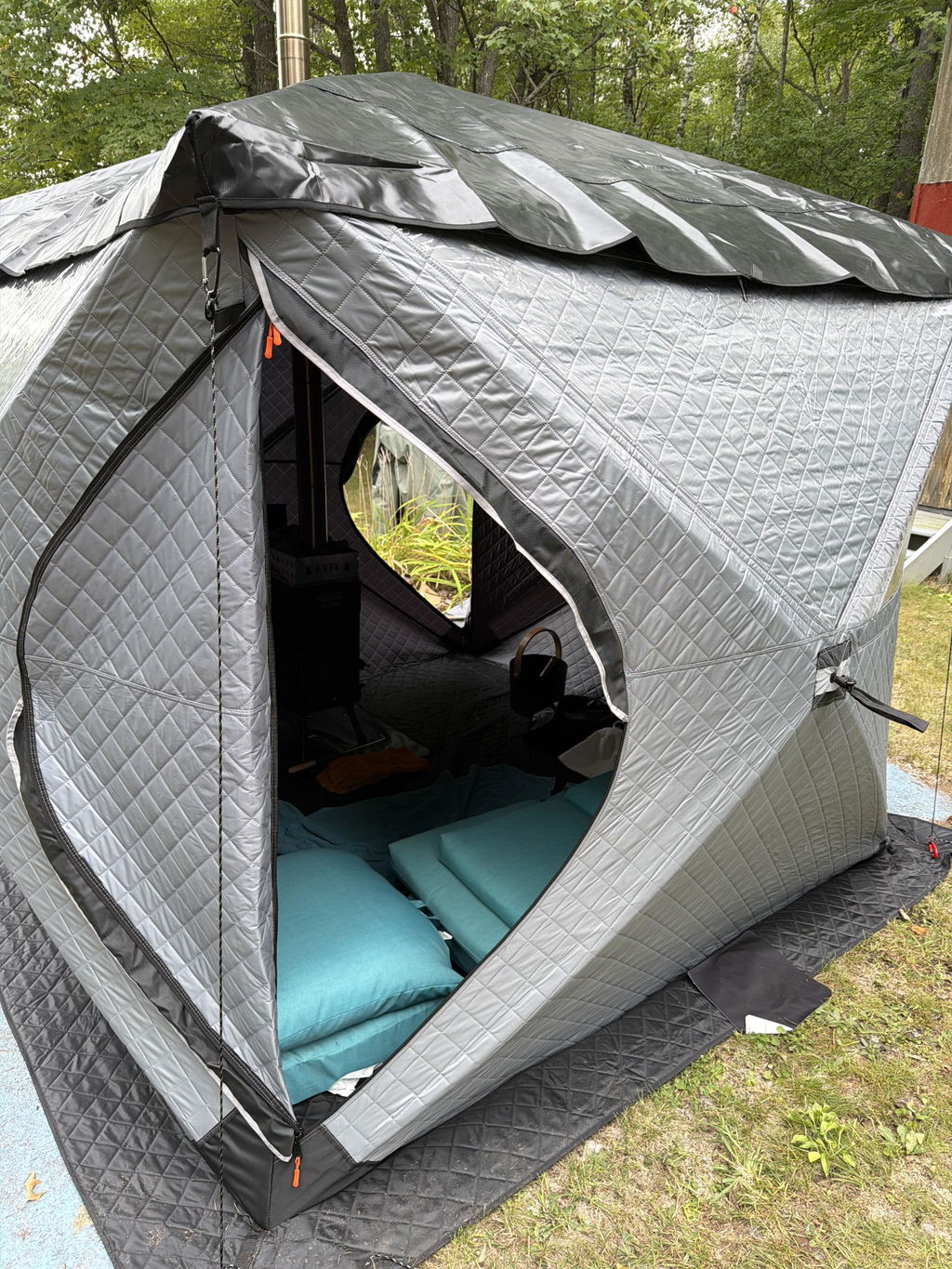
The KYFE Portable Sauna Tent is a wood-fired sauna that sets up in 5 minutes and reaches 200°F in under 30 minutes. It needs no electricity. Every kit comes with a thermometer, so you can see how hot it is, and a rock cage with 35 lb of volcanic sauna rocks, so you can pour water for steam. The Mini fits 2 to 3 people and the Large fits 6 to 8, which makes it easy to sauna with a training partner.
Each tent also comes with a free cold plunge. If you like contrast sessions, you can set them up side by side, and keep the plunge for days you are not lifting.
Use it outdoors only, at least 3 feet from any structure, with no branches over the chimney, and check your local fire department's rules first. Never leave the fire unattended. You may be able to pay with HSA or FSA funds through Truemed, and you can return an unused sauna within 60 days of delivery.
See the KYFE wood-fired sauna tent
Frequently asked questions
Can you lose belly fat in a sauna?
We found no study showing that sauna bathing reduces belly fat, or that it can slim any one part of your body. The scale may read lower right after a session because you have lost water weight, but that comes back when you drink. In the trials we read, regular exercise is what changed body composition.
How often should I sauna to lose weight?
No study has tested a sauna schedule for weight loss. Two or three sauna sessions a week, after workouts, is a sensible start. The long-term Finnish research found that men who went 4 to 7 times a week had a lower risk of fatal heart disease, but it did not look at weight. Build up slowly and stay hydrated.
Does sauna burn fat?
There is no good evidence that it does on its own. In a 2020 study, eight sauna sessions over 4 days did not change body composition in overweight adults. In a 2022 trial, exercise improved body composition, and adding a sauna after workouts improved fitness and blood pressure more, without listing extra fat loss.
How many calories do you burn in a sauna for 30 minutes?
Some, because your heart rate rises and your body works to cool down. In one study, energy expenditure rose across four sauna sessions and correlated with body size. The exact number depends on your size and the heat. Our separate guide on whether a sauna burns calories goes through it.
Does a sauna make you look leaner or debloat you?
The scale may read a little lower right after a sauna because you have sweated out fluid. That is temporary weight loss. Once you drink, the fluid comes back. We found no study showing that a sauna changes how much body fat you carry, so do not expect a lasting leaner look from the heat alone.
How long in a sauna to lose 2 pounds?
Do not try. Any 2 pounds you lose in a sauna is fluid, not fat, and you are meant to drink it back. In one study, overweight men lost 0.65 kg, about 1.4 pounds, over a full hour of sauna rounds. Pushing past that to hit a number raises your risk of dehydration and heart strain.
What should you not do after a sauna?
Do not stand up fast, since blood pressure can drop below where it started after a session. Do not drink alcohol: a medical review warned that alcohol during sauna bathing raises the risk of low blood pressure, irregular heartbeat and sudden death. Do not skip rehydration, and do not judge your weight on the scale right after you get out.
Does going in the sauna after a workout help with weight loss?
No study shows that it burns extra fat. It is still the most practical time to go. In a 2022 trial, adults who added a 15-minute sauna after each workout for 8 weeks improved their fitness and blood pressure more than those who only exercised. Drink water first, since you have already sweated.
Sauna Temperature: How Hot Should a Sauna Be?
Infrared vs Traditional Sauna: What's Different and Which to Choose